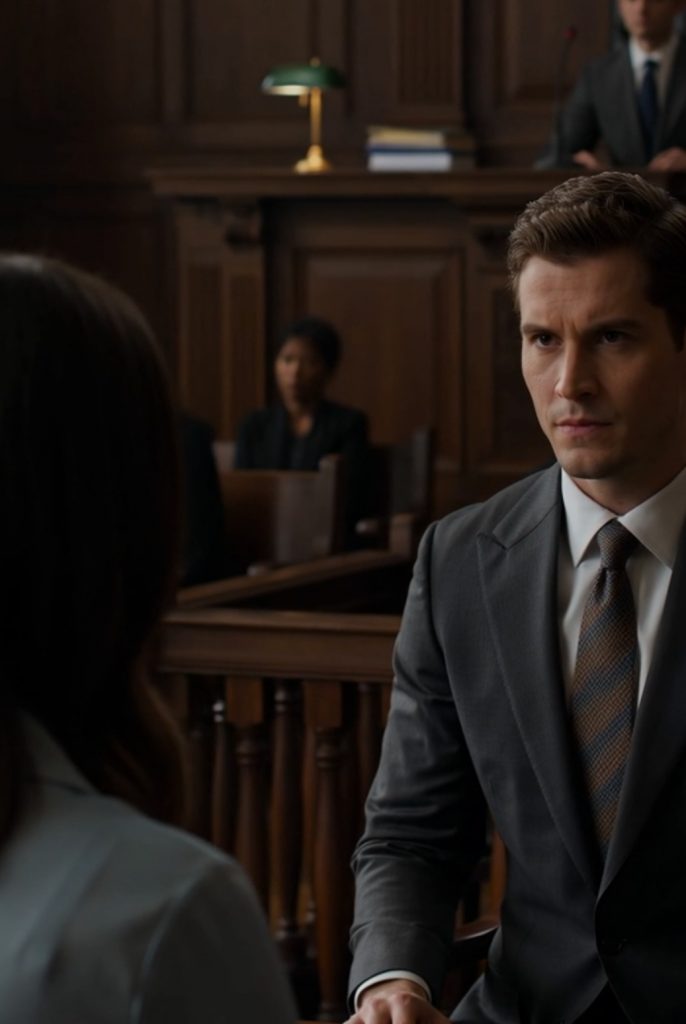
The courtroom air was heavy, stagnant, and tasted faintly of floor wax, old paper, and a crushing, suffocating desperation. For Clara, the mahogany-paneled walls felt less like a sanctuary of justice and more like the jagged teeth of a closing trap.
She sat motionless in the defendant’s chair, her hands tightly clasped in her lap to hide the fact that they were trembling—a subtle, betraying movement she knew Arthur would exploit the moment he looked her way.
Every breath felt like a labor, a conscious effort to keep her composure as the eyes of the jury, the gallery, and the cold, unyielding judge weighed upon her.
Across the aisle, Arthur sat with the composure of a man who didn’t just own the room; he owned the very reality within it. He was a master of the performative mask—perfectly tailored suit, a face etched with a practiced, sorrowful concern that the jury devoured as if it were gospel.
He didn’t need to shout to exert control. A mere shift in his posture, a single, piercing glance toward the defense table, was enough to make the air in Clara’s lungs turn to ice.
He had successfully painted her not as a grieving mother fighting for her son, but as a fractured, unstable woman spiraling into the abyss of her own delusion.
To the public, he was the devoted father forced to protect his child from an erratic mother; to Clara, he was the architect of her destruction, a man who had systematically dismantled her life piece by agonizing piece.
The history of their downfall was not a singular event, but a slow, calculated erosion. It had started years ago with small, insidious gaslighting tactics—doubting her memory, making her question her own perceptions, and slowly insulating her from the support of her friends and family.
Arthur had made sure that when the time came to take Leo, there would be no one left to vouch for her sanity. He had been meticulous, planting seeds of doubt in their social circle, fabricating medical reports that hinted at a non-existent bipolar disorder.
Every emotional outburst she had—legitimately provoked by his own psychological warfare—was documented as proof of her incapacity. She felt the heavy, stifling weight of his narrative pressing down on her, an invisible structure of lies so dense it seemed impossible to penetrate.
And then there was Leo. Seeing her six-year-old son standing at the witness box felt like watching a lamb being led to the slaughter. His small frame seemed to shrink under the harsh, artificial glare of the overhead lights, his knuckles white as he gripped the edge of the polished wood.
Clara’s heart fractured in rhythmic, agonizing pulses. She could see the exact moment the fear took hold of him—the way his eyes darted toward his father, a silent, terror-filled plea that Arthur met with a cold, unblinking warning.
Leo looked so small, so devastatingly fragile, caught in the crossfire of a war he was never meant to witness.
The silence that stretched across the room was suffocating. The judge’s gavel was a distant, muted sound, muffled by the roaring blood in Clara’s ears. She knew what Arthur had done. She knew the threats whispered behind closed doors, the late-night intimidations that had systematically dismantled her confidence, her reputation, and her sanity.
Arthur hadn’t just taken her son; he had rewritten the history of their lives, turning every act of her love into a symptom of her “instability.” Every bedtime story, every doctor’s appointment, every park visit had been curated by him to fit into a grand design of her eventual downfall.
“Leo,” the opposing counsel began, his voice dripping with a predatory, artificial gentleness. “Do you remember the night of the accident? The night your mother… lost control?”
Clara felt a scream rising in her throat, a primal, suffocating sound she forced herself to swallow. Leo looked at his mother. In that brief, crystalline second, Clara saw the war raging behind his tear-filled eyes.
He was trapped between the crushing gravity of his father’s manipulation and the fragile, fading memory of his mother’s warmth. She watched the internal battle, her own spirit aching to reach out and pull him from that box, to tell him that he didn’t have to carry the weight of his father’s sins.
But she remained rooted to her seat, paralyzed by the legal constraints of a game she had already lost.
The courtroom waited, a collective, hungry beast eager to devour the truth. Arthur leaned back, a ghost of a victorious smirk playing on his lips, certain that he had already won.
He had forgotten one fundamental truth: that in the architecture of a lie, the smallest crack—the smallest, most innocent voice—could bring the entire empire of deception crashing down upon his head.
Clara leaned forward, her entire existence suspended in the heart-wrenching, terrifying beat of her son’s impending silence. She looked at him, trying to project every ounce of love, safety, and truth she had ever given him, praying that it would be enough to pierce the armor of his father’s intimidation.
“Leo, please answer the question,” the lawyer prompted again, his voice becoming sharper, losing the veneer of kindness.
Leo’s lower lip trembled. He looked at the sheet of paper in his hands—a piece of evidence he had been instructed to bring, a piece of truth that had been kept from the light for far too long.
Clara realized then that the trial wasn’t just about custody; it was about the survival of the human spirit in the face of absolute, systemic corruption. Arthur’s power was vast, but it was hollow.
He relied on fear, while Clara relied on the truth. And in the silence of the courtroom, Clara began to realize that the truth, however buried, always has a weight of its own.
As the seconds ticked by, the pressure in the room mounted, nearing an explosive point. The judge frowned, his patience thinning. Arthur shifted, his smugness flickering for a fraction of a second as he realized that, for the first time in his life, he couldn’t predict the outcome.
Clara held her breath, her eyes locked with Leo’s. She realized that her son was not just a victim; he was the final arbiter of this entire ordeal. The entire machinery of the court, the legal maneuvering, the decades of Arthur’s dominance—it was all now focused on the small, trembling boy in the box.
Don’t look at him, Leo, she prayed, her soul reaching out to him across the divide. Look at the truth. Please, find the truth. In that moment of suspended animation, Clara understood that the fight was not lost. Even if the verdict went against her, even if Arthur’s lies prevailed today, the truth had found a voice. The silence, previously her prison, was now the vessel for her deliverance.
As Leo finally inhaled, his eyes hardening with a sudden, startling clarity, Clara felt a shift in the air. The trap was still there, the teeth were still jagged, but for the first time in years, she wasn’t just an animal waiting for the strike. She was a mother, and her truth was about to be spoken.
The courtroom, the judge, the lawyers, and even Arthur himself were about to find out that a lie, no matter how carefully constructed, cannot withstand the simple, devastating power of a child’s memory. The arrival of this moment had been a lifetime in the making, and as Leo began to open his mouth, the atmosphere in the room changed forever.