Chapter 1: The Dust of Four Decades
The scent of yeast and scorched sugar had been permanently tattooed into the marrow of my bones. For nearly forty years, I had been the silent, flour-dusted sentinel of Kensington Avenue. Long before the sun even considered cresting the jagged skyline of the city, I was awake. I was Elias Thorne, the proprietor, head baker, and sole employee of The Golden Sheaf.
My bakery was an anachronism, a stubbornly beating heart encased in old, mortar-crumbling brick, sitting on a quiet corner that the modern world seemed intent on swallowing whole. The faded, hand-painted sign above the door swung on rusted iron hinges, offering a daily, silent greeting to the sanitation workers and night-shift nurses who constituted my early morning clientele. I had never amassed a fortune. My bank accounts were perpetually anemic. But wealth, I had long ago decided, was a subjective metric. I knew the names of the stray dogs, the secrets of the lonely widows, and the exact coffee order of the beat cops. I belonged to the neighborhood, and the neighborhood belonged to me.
Yet, nostalgia is a poor currency to offer the bank.
The gentrification of the city had crept up like a slow, suffocating ivy. The mom-and-pop hardware store across the street had been gutted and replaced by a sterile, glass-fronted fitness boutique. The local butcher had been priced out, his shop now a high-end dog grooming salon. I was the last holdout, a stubborn weed growing through the cracks of a corporatized sidewalk.
As I stood at the heavy oak kneading table, plunging my aching, arthritic hands into a mound of sourdough, my gaze drifted to the small stack of envelopes resting ominously near the cash register. They were stamped with aggressive, crimson ink: FINAL NOTICE. INTENT TO SEIZE.
My chest hollowed out. The debts had piled higher than the flour sacks in my stockroom. Bills, high-interest predatory loans I had taken to fix the failing industrial oven, crushing property taxes—they had formed a predatory noose around my neck. At seventy years old, my body was failing, and my sanctuary was collapsing around me.
I paused my kneading, closing my eyes, the familiar sting of exhaustion burning behind my eyelids. Whenever the despair threatened to pull me under, my mind invariably drifted back to a specific, haunting memory from twenty years ago.
It had been a brutal, freezing November afternoon. The sky was the color of a bruised plum. Through the fogged, rain-streaked glass of my display window, I had noticed a child.
She couldn’t have been older than nine. She stood perfectly still on the cracked sidewalk, shivering in a thin, painfully worn yellow dress that offered no defense against the biting wind. Her sneakers were duct-taped at the toes. But it wasn’t her poverty that had arrested my attention; it was the sheer, devastating hunger in her eyes. Her gaze was locked, unblinking, on a single, thick-cut roast beef and cheddar sandwich wrapped tightly in white butcher paper.
I remembered wiping my hands on my apron, stepping out from behind the safety of the counter, and walking to the front door. The bell had chimed overhead as I pushed it open, the freezing wind instantly biting at my flour-covered arms.
“Are you hungry, little one?” I had asked, my voice barely a raspy whisper over the howling wind.
She had flinched, stepping back as if expecting a blow. She hesitated for a long, agonizing moment. Then, looking down at her broken shoes, she offered a single, imperceptible nod.
The memory of that day was the only thing keeping my heart beating in the present. But as I opened my eyes and looked at the stack of final notices, I knew memories couldn’t pay the mortgage.
Suddenly, the brass bell above the front door violently shattered the quiet morning. I looked up, the blood draining from my face.
The executioners had arrived.
Chapter 2: The Mark of the Wheat Stalk
I wiped my trembling hands on my apron, leaving streaks of damp flour across the canvas. My heart hammered a frantic, irregular rhythm against my ribs as three men stepped into the warmth of The Golden Sheaf.
The contrast between them and my sanctuary was jarring, almost violently offensive. They wore identical, sharply tailored black suits that smelled of sterile corporate lobbies and expensive, synthetic cologne. The man in the center, clearly the apex predator of the trio, carried a thin, ominous leather portfolio.
His name was Sterling. I knew him from the relentless, harassing phone calls that had plagued my nights for the past six months. He was an acquisitions agent for a massive, faceless real estate conglomerate that wanted my corner lot for a luxury condominium development.
“Mr. Thorne,” Sterling purred, his voice slick and devoid of any human warmth. He didn’t look at the racks of fresh brioche or the steaming trays of croissants. He looked at the walls as if sizing up a coffin. “Today is the final deadline. The grace period expired at midnight.”
I stood behind the counter, suddenly feeling every single one of my seventy years. The aching in my spine flared into a dull roar. A few early morning customers—Mrs. Higgins clutching her poodle, and a young barista from down the street—stood frozen by the window, watching the tragedy unfold with nervous, wide eyes.
“I… I just need another week,” I stammered, hating the desperate, pathetic tremor in my own voice. “The holiday season is coming. The catering orders will pick up. I can have a partial payment by Friday.”
Sterling didn’t even bother to feign sympathy. He unclasped the leather portfolio, the sound unnervingly loud in the silent bakery. “We are no longer accepting partial payments, Mr. Thorne. You are in default. The bank has officially transferred the deed to my firm. You have exactly one hour to collect your personal effects before the locksmith arrives to secure the premises.”
One hour.
Forty years of early mornings, of burnt fingers, of feeding a community, erased by a signature on a piece of paper. The injustice of it tasted like ash in the back of my throat. I looked down at the scratched wooden counter, my mind desperately trying to retreat, to find any shred of comfort.
It rushed back to the girl in the yellow dress.
Twenty years ago, after she had nodded, I hadn’t asked for explanations. I hadn’t lectured her about pulling herself up by her bootstraps. I had simply walked to the display case, retrieved the roast beef sandwich, wrapped it in a second layer of thick white paper to keep the heat in, and walked back out into the freezing cold.
I handed it to her. She accepted the heavy, warm parcel with both of her tiny, dirt-smudged hands, treating it as if I had just handed her the Holy Grail. I watched her throat work as she swallowed hard, thick tears instantly pooling in her wide, dark eyes.
“I don’t have any money,” she had whispered, her voice cracking, anticipating the catch, the cruel trick that the world usually played on the vulnerable.
“That’s okay,” I had smiled, a genuine, heartbreaking smile. I reached into my pocket and pulled out a small, folded paper napkin. Years earlier, during a quiet afternoon, I had absentmindedly drawn a small, intricate symbol on it with a black fountain pen—a single stalk of wheat encircled by a sun. It was meaningless to anyone else. It was just my personal mark.
I pressed the folded napkin into her cold, trembling palm. “Someday, when you are strong, and when you are able… just help someone else.”
The little girl had stared at me, then at the napkin, then back at my face. She offered a single, profound nod before turning and vanishing down the rain-slicked sidewalk, swallowed by the gray city. I never learned her name. Over the decades, her specific facial features had blurred in my mind, but the raw, unfiltered gratitude in her eyes had remained burned into my soul.
“Mr. Thorne,” Sterling’s sharp voice snapped me violently back to the present. He slid a thick stack of legal documents across the counter, accompanied by a sleek, silver pen. “Sign the surrender of premises. If you refuse, we will have the authorities physically remove you.”
I stared at the pen. It looked heavier than a broadsword. My hands shook so violently I had to press them flat against the wood. I had no answer. No hidden wealth. No miraculous solution. Only the heavy, suffocating silence of defeat.
I reached out, my fingers trembling as they closed around the cold metal of the pen.
But before the nib could touch the paper, the roar of a high-performance engine vibrated the front windows.
A massive, sleek black SUV, tinted so darkly it looked like a polished obsidian stone, aggressively pulled up directly to the curb, parking illegally in the loading zone.
The heavy rear door swung open.
Chapter 3: The Ghost in Beige
The atmosphere inside the bakery shifted instantly. Even Sterling paused, his arrogant posture stiffening as he looked over his shoulder. The two junior associates behind him exchanged confused, nervous glances.
A woman stepped out of the vehicle.
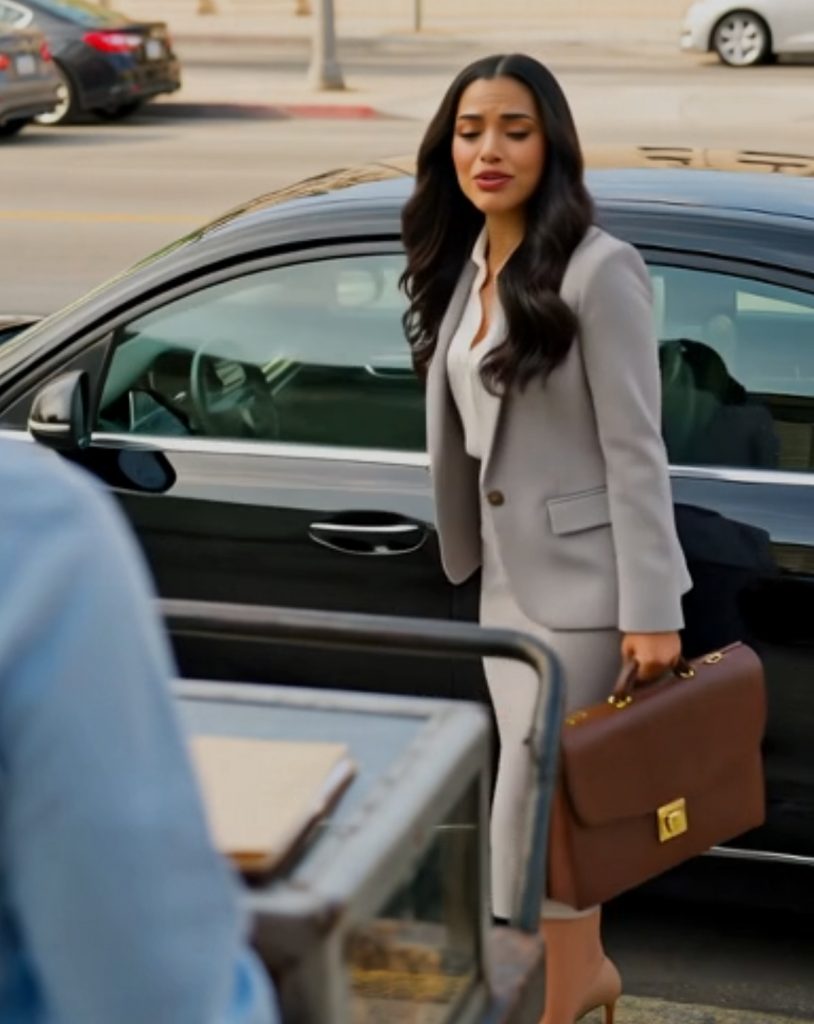
She moved with an effortless, terrifying authority. She wore an elegant, tailored beige suit that likely cost more than my commercial oven. Her stride was confident, sharp, and purposeful. Large, expensive designer sunglasses obscured the upper half of her face. She was the kind of person who clearly belonged in the cutthroat environment of high-rise boardrooms, private equity meetings, and VIP airport lounges.
She did not belong on the flour-dusted floor of a struggling, neighborhood bakery.
Yet, she walked directly toward the glass door, pushing it open with a firm, manicured hand. The bell chimed, sounding almost musical this time. She ignored the gawking customers. She completely ignored Sterling and his two corporate henchmen.
She walked straight to the counter and stopped directly in front of me.
Sterling cleared his throat, an irritating, condescending sound. “Excuse me, ma’am, this establishment is currently closed for foreclosure proceedings. You’ll need to step outside.”
The woman didn’t even turn her head to acknowledge him. Slowly, deliberately, she reached up and removed her sunglasses, folding them and sliding them into the breast pocket of her blazer.
I stared at her face.
My breath hitched in my throat. A bizarre, powerful wave of déjà vu washed over me. Her cheekbones were sharp, her jawline strong, but there was something deeply, undeniably familiar about the shape of her dark eyes. I searched the archives of my exhausted brain, trying to place her. A former employee? The daughter of a long-lost friend?
“I am speaking to you,” Sterling snapped, his patience fraying. He stepped forward, invading her personal space. “This property is being seized by—”
“How much does he owe?”
Her voice was calm, melodic, but layered with an absolute, unyielding steel that stopped Sterling dead in his tracks.
The debt collector frowned, thrown completely off balance by her sheer dominance of the room. “I beg your pardon?”
“Are you hard of hearing, or just incompetent?” The woman finally turned her head, fixing Sterling with a stare so cold it could have frozen the oven. “I asked you for the exact sum of Mr. Thorne’s outstanding debt. Principal, interest, late fees, and your firm’s predatory penalties. Give me the number.”
Sterling bristled, his ego bruised. He opened his portfolio, leafing through the pages with sharp, angry movements. “This is highly irregular, and frankly, none of your business. The total outstanding balance, including liens and legal fees, is three hundred and forty-two thousand dollars. A sum well beyond recovery.”
It was a staggering, astronomical number. Hearing it spoken aloud felt like a physical punch to my gut. It was a sum I couldn’t have paid if I lived for another two hundred years.
I expected the woman to scoff, to shake her head and walk away. It was an absurd amount of money to spend on a decrepit bread shop.
Instead, she didn’t react to the figure at all. She didn’t flinch.
She turned back to me, her severe expression softening into something incredibly vulnerable. Slowly, she raised her right hand and opened her palm, resting it gently on the scratched wooden counter.
Resting in the center of her palm was an old, severely worn paper napkin.
It had been folded and unfolded countless times, the edges frayed and soft like ancient parchment. But right in the center, drawn in faded, bleeding black ink, was a symbol.
A single stalk of wheat, encircled by a sun.
Chapter 4: The Ledger of Grace
I froze.
The ambient noise of the bakery—the hum of the refrigerators, the distant wail of a siren, the nervous shuffling of the customers—vanished entirely. The world narrowed down to that fragile, decaying piece of paper resting on the counter.
My hands began to shake, not with fear this time, but with a seismic, world-altering shock. I recognized it instantly. It was the mark. It was my mark.
I looked up from the napkin, my eyes meeting hers. The sharp, commanding corporate titan was gone. Standing in front of me was the ghost of a shivering child in a worn yellow dress, her broken shoes replaced by designer leather, but the eyes… the eyes were exactly the same.
“So you kept it…” my voice broke, reduced to a hoarse, trembling whisper. The tears I had fought back all morning suddenly flooded my vision, blurring the edges of the room.
The woman’s eyes shimmered, mirroring my own tears. A single drop escaped, tracking down her perfectly powdered cheek.
“You were that little girl?” I stammered, gripping the edge of the counter to keep my knees from buckling.
She nodded, a brilliant, radiant smile breaking through her composed facade. “I never forgot, Mr. Thorne. Not for a single day.”
Sterling, thoroughly confused and increasingly agitated, slapped his hand against the portfolio. “What is this? Some kind of theatrical stunt? I don’t care about your sentimental garbage. If the debt is not paid immediately via a certified wire transfer, the property is ours.”
The woman—whose name I still didn’t know, but whose soul I recognized completely—turned back to the debt collector. The vulnerability vanished, replaced by the lethal, calculating executive.
“Calculate the final payoff amount,” she commanded, her voice ringing with absolute authority.
Sterling blinked, his arrogant sneer faltering. “What?”
She took a step closer to him, invading his space, forcing the man to physically lean back. She reached into her blazer and pulled out a heavy, black titanium checkbook and a gold pen.
“I’ll pay all of it,” she said evenly. “Right here. Right now. You will draft a release of lien, you will sign it, and you will vacate this property.”
Silence. The kind of silence that feels heavy, thick, and almost holy.
The entire street outside seemed to stop. Mrs. Higgins pressed her hand to her mouth. The barista stared in open-mouthed shock. I stood paralyzed, unable to comprehend the magnitude of what was happening.
“You… you are offering to pay three hundred and forty-two thousand dollars?” Sterling stammered, his professional facade crumbling into disbelief. “For a failing bakery?”
“I am paying a debt,” the woman corrected sharply, her eyes flashing with a fierce, protective fire. “Now process the paperwork before I have my legal team investigate your firm’s aggressive collection tactics and bury you in litigation until you retire.”
Sterling didn’t argue. He practically tripped over himself, his hands shaking as he pulled out a calculator, frantically punching in the numbers, terrified of the woman standing before him.
Within minutes, the impossible had occurred. The heavy titanium check was signed and torn from the ledger. Documents were hastily drafted, stamped, and signed. Sterling and his associates packed their briefcases with an embarrassing urgency, eager to escape the suffocating gravity of the woman’s presence.
They practically ran out the door, the bell chiming a frantic goodbye.
The threat was gone. Every lien removed. Every harassing phone call silenced. The bakery, the brick, the ovens, the flour—it all belonged to me again. Free and clear.
I stumbled around the counter, my legs finally giving out. I collapsed into a nearby wooden chair, burying my face in my flour-stained hands. I broke down. Great, heaving, ugly sobs tore through my chest.
It wasn’t because the crushing weight of the debt was gone, though the relief was staggering. I cried because, in that singular, defining moment, the universe had revealed its architecture to me. I finally understood the truth.
The sandwich had never been the gift. Epilogue: The Harvest
The kindness had been the gift. The simple act of seeing a human being when the rest of the world had chosen to look away. And after twenty long, arduous years, that kindness had matured, compounded, and found its way back home.
The woman knelt beside my chair, disregarding the flour that dusted the knees of her expensive suit. She placed her warm, manicured hand over my trembling, arthritic ones.
“But why?” I wept, looking at her through my tears. “You didn’t have to do this. It’s too much.”
She smiled, wiping a tear from her own eye. “Because when I was starving, when my family had nothing, everyone else on this avenue looked away. They saw a nuisance. A stray.” She looked around the bakery, taking in the old walls, the glass cases, and the smell of the yeast. Then she looked back into my eyes. “You didn’t. You saw a child.”
She stood up slowly, smoothing her blazer. She had given me back my life, my dignity, and my legacy.
As she prepared to leave, she paused at the heavy glass door—the exact same door she had once pushed open as a frightened, desperate child with broken shoes. She placed her hand on the brass handle, then looked over her shoulder, the morning light catching her silhouette.
“Remember what you told me?” she asked softly.
I nodded, the tears still tracking freely down the deep lines of my face. “To help someone else.”
The woman offered one last, devastatingly beautiful smile.
“I did.”
She pushed the door open, stepped out into the crisp morning air, and walked back to the idling SUV. The heavy door closed with a solid thud, and the vehicle glided away, disappearing into the chaotic flow of the city traffic.
She left behind a bakery that smelled of fresh hope. She left behind a deeply grateful old man. And she left behind absolute, undeniable proof that sometimes, the smallest seed of compassion, planted in the darkest of times, can grow into a harvest far bigger than anyone could ever imagine.
If you want more stories like this, or if you’d like to share your thoughts about what you would have done in my situation, I’d love to hear from you. Your perspective helps these stories reach more people, so don’t be shy about commenting or sharing