Life can change in a heartbeat, sometimes in ways no one could have predicted. For Soudi Al Nadak, that change came when her path crossed with Jamal Al Nadak, an Emirati businessman whose world seemed galaxies away from the quiet English countryside where she grew up.
Soudi’s childhood was marked by simplicity—rolling green fields, small-town community, and days that followed a gentle rhythm. Her family valued education, independence, and quiet perseverance, values that shaped her outlook as she matured. By her early twenties, she made a bold decision: to move to Dubai to pursue her studies. Dubai, with its glass towers that touched the clouds, sprawling malls filled with luxury brands, and its pulse as a global crossroads, could not have been more different from her rural beginnings. Yet it was here, amid the desert’s heat and the city’s glitter, that Soudi’s life pivoted.
Jamal Al Nadak was no stranger to success. Coming from an affluent and respected Emirati family, he had built a reputation as a businessman with vision and quiet discipline. Unlike many who flaunted their wealth, Jamal’s demeanor was reserved. He carried his success with understated elegance, preferring substance over show. When he met Soudi, he was immediately drawn to her confidence and her ability to navigate a culture so different from her own with curiosity rather than judgment. Soudi, for her part, was intrigued by the world he invited her into—exclusive travel on private jets, dinners at Michelin-starred restaurants, and gatherings marked not by ostentation but by refined taste.
Their courtship was fast by some standards, deliberate by others. Jamal valued tradition and made sure his intentions were clear from the beginning. Soudi appreciated that directness. Where many relationships at her age felt undefined or casual, this one had structure, respect, and vision. By 2020, the couple had decided to marry.
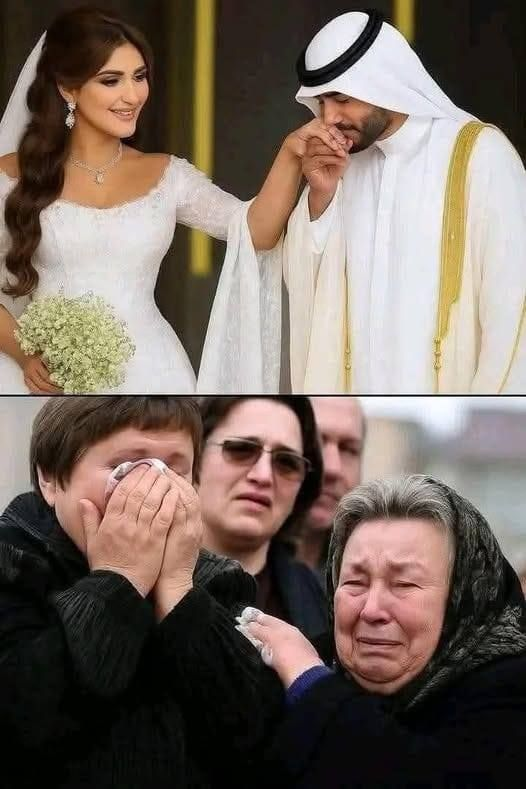
The wedding itself became a symbol of fusion. Held in Dubai, it blended British and Emirati traditions in a way that left guests speaking of it long afterward. English roses, chosen for their delicate beauty and connection to Soudi’s heritage, decorated the venue, while Arabic calligraphy adorned invitations and décor, weaving Jamal’s culture into every detail. The ceremony wasn’t about overwhelming displays of wealth but about elegance. Sophistication whispered from the details—the cuisine, the music, the balance of tradition and modernity. It was a union of two people, but also of two worlds.
Shortly after the ceremony, a video clip from the wedding began circulating online. In an era where social media often dictates what stories capture public imagination, their union quickly became a point of fascination. The clip showed glimpses of their lavish lifestyle—guests arriving in designer attire, glimpses of high-end décor, a fleeting shot of Soudi’s gown shimmering under golden light. It didn’t take long for the video to go viral, gathering millions of views and sparking debate across comment sections worldwide.
Many people were enchanted by what they saw, declaring it a modern fairytale. To them, Soudi embodied the dream of finding love that transcends culture, geography, and class. They celebrated the idea of two people, seemingly from different worlds, finding common ground in respect and affection. For some, it was proof that true love knows no boundaries.
But not everyone viewed it through such romantic eyes. Critics suggested the marriage was more about privilege and social mobility than affection. Skeptics online pointed out the vast differences in wealth and background, questioning whether love could truly flourish when one partner enters a world of immense affluence. Some wondered if Soudi had married into a life of convenience and status rather than genuine romance. The debates reflected deeper global tensions: how we perceive marriages that bridge not just cultures, but also economic divides.
Yet behind all the noise, the reality was simpler. Soudi and Jamal’s relationship was theirs alone, lived outside the judgments of strangers. The fascination with their story revealed more about public curiosity than about the couple themselves. People are drawn to cross-cultural romances because they mirror larger human questions: how do we connect across differences? How do tradition and modernity coexist? What does privilege mean when it intersects with intimacy?
As time passed, their marriage became more than just a viral story. It became a living example of how personal choices ripple into public conversations. In Dubai, they settled into a life that balanced privacy with prominence. Soudi navigated her new role with grace, embracing aspects of Emirati culture while holding on to the parts of her English upbringing that defined her. Jamal continued his business ventures, now with a partner who brought fresh perspective and adaptability.
Their life together was not without challenges. Moving between two cultural frameworks required compromise. At family gatherings, Soudi sometimes felt the weight of expectations unfamiliar to her, while Jamal occasionally had to explain British customs to relatives who had never experienced them. Yet they found strength in those moments, choosing to see differences not as barriers but as opportunities to grow closer.
The story of Soudi and Jamal continues to fascinate not because it is perfect, but because it captures so many themes of our time—globalization, cultural blending, love in the spotlight, and the way private choices become public conversations. For some, it’s aspirational, the kind of romance that reads like fiction. For others, it’s a reminder of the complexities beneath glossy surfaces.
What remains undeniable is that their wedding marked not just the joining of two individuals, but the start of a narrative that bridged continents. Whether seen as a fairytale, a social transaction, or simply a love story, it speaks to the enduring human fascination with what happens when two worlds collide and choose to become one.