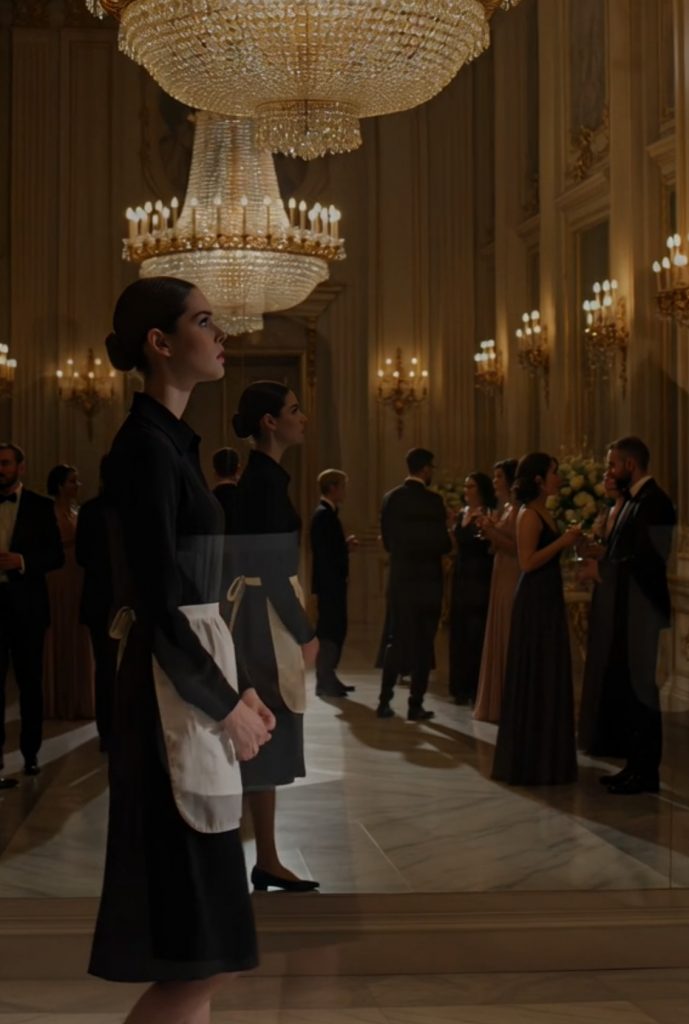
The crystal chandelier above the ballroom of the Rivas Estate didn’t just illuminate the room; it seemed to judge it. It cast a harsh, unforgiving light on the polished marble floors, reflecting the vanity of the city’s elite. For Clara, the ballroom was a labyrinth of mirrors and glass, each reflection reminding her of exactly where she did not belong.
Clara stood in the shadows near the service corridor, her heart hammering against her ribs like a trapped bird. She was nineteen, dressed in a black polyester uniform that pinched at her shoulders and chafed against her neck. To everyone else in the room, she was just “the help”—an invisible cog in the machinery of an opulent evening. But tonight, the invisibility felt like a shroud. She wasn’t supposed to be here. She was supposed to be in the back, clearing debris from the kitchen, but the magnetic pull of the center stage had been too strong.
Julian Rivas was there.
He stood near the fountain of champagne, his charcoal suit tailored to perfection, his jawline etched with the kind of aristocratic coldness that Clara had spent years idolizing from afar. He was the city’s golden boy, the man whose face graced the covers of business journals, a man who, in Clara’s desperate, youthful imagination, represented everything she lacked.
Her gaze was fixed on him, a silent, painful devotion that had been the only anchor of her lonely existence since she had been orphaned at seven. She had lived in a world of scrap-metal jobs and empty cupboards, while he lived in a world of private jets and boardroom coups. Yet, she had convinced herself—as only the truly lonely can—that he was the answer. That if she could just get close enough, if she could show him that she was more than the grime of the docks, he would see her.
“Move, you clumsy wretch!”
The voice shattered her daydream. Clara spun around, her heel catching on the hem of a guest’s gown. She stumbled, her center of gravity failing her. Her tray, balanced precariously in her left hand, tilted. A flute of vintage champagne tipped, the golden liquid spilling in a slow-motion arc before splashing violently across the emerald silk gown of Cynthia Vane.
Cynthia, the daughter of a rival shipping magnate and a woman whose social status was as sharp as her tongue, let out a shriek that silenced the nearby string quartet. The ballroom, once filled with the murmur of polite indifference, suddenly coalesced into a circle of predatory eyes.
“My dress!” Cynthia screamed, her hands flying to the wet patch spreading across her waist. She lunged forward, not to help, but to strike. The slap was resonant and cruel, sending Clara reeling backward into the marble floor.
“I am so sorry, Miss, I—” Clara began, her voice trembling, her hands instinctively reaching out for the broken glass on the floor.
“Don’t touch me!” Cynthia hissed, looming over her. “Do you have any idea how much this cost? You filthy little gutter-rat! I watched you lurking in the shadows all evening, staring at Julian like you had a right to be in his presence. You look like you haven’t had a bath in a week, and your clothes smell of cheap detergent and poverty.”
The laughter rippled through the crowd—the polite, muffled laughter of the wealthy, the kind of sound that hurts worse than a physical blow because it feels so civilized, so certain of its own correctness.
Clara scrambled to her feet, her face burning, her eyes stinging with the tears she refused to shed. She looked for him. She searched the circle of faces, her eyes desperately seeking Julian. He was there, standing only a few feet away, watching the spectacle with the detached interest of a man observing a traffic accident. His expression didn’t change. There was no flicker of recognition, no spark of mercy. He simply adjusted his cufflinks and took a sip of his own drink, his eyes sliding over Clara as if she were a piece of furniture that had suddenly broken.
“This,” Cynthia continued, stepping closer and digging her manicured fingernails into Clara’s shoulder, “is what happens when you allow the lower classes to scrub your floors. They forget their place. They think they can stand in the same room as us, breathe the same air as us, even dream the same dreams. But look at you, Clara. You’re nothing. You’re a smear of filth on a beautiful evening.”
The cruelty wasn’t just in the words; it was in the total, systemic erasure of her humanity. Clara realized, with a clarity that cut deeper than any knife, that to these people, her pain was an inconvenience, her presence a stain, and her very existence a joke.
“I—I work here,” Clara whispered, her voice cracking. “I didn’t mean to—”
“You work here because you are desperate,” Cynthia interrupted, her tone dripping with mock pity. “And you will always be desperate. You’ll spend the rest of your life scraping by, hoping for a miracle that isn’t coming. People like you don’t rise. You don’t marry into this world. You serve it, and then you die in it.”
The humiliation was total. It was a weight that pressed down on Clara’s chest, making it hard to breathe. She looked back at Julian one last time. He had turned away, engaged in a conversation with a tech billionaire, the topic clearly far more engaging than the whimpering servant at his feet. In that moment, the idol she had built in her mind shattered. He wasn’t a savior. He was a participant. He was the architect of the very hierarchy that kept her in the dark.
But as Cynthia turned to walk away, she dropped something—a small, silver key engraved with a strange, jagged crest, a symbol Clara recognized from the old newspaper clippings her mother had hidden in a locked tin box under their bed before she died.
Without thinking, Clara’s fingers closed over the fallen key. It was icy cold, pulsating with a strange, dull vibration against her palm.
“Get her out of here,” Cynthia commanded, tossing her glass into the fountain with a clatter. “If I see her face again, I’ll ensure this entire catering company is liquidated by morning. I don’t want a single trace of her left in this ballroom.”
Security stepped forward—two men in dark suits, their movements practiced and indifferent. They grabbed Clara’s arms, their grip bruising. As they dragged her across the marble, Clara didn’t struggle. She let her body go limp, her gaze fixed on the back of Julian Rivas’s head.
She felt the cool night air of the garden hit her face as they threw her out the back service door, the heavy oak slamming shut behind her. She landed on the damp grass, the silence of the night a stark contrast to the opulence she had just fled. The muffled sounds of the music continued, a mocking lullaby for her downfall.
Clara lay there for a long time, the mud soaking through her uniform, the stinging in her cheek a reminder of the price she had paid for wanting something she couldn’t have. She looked up at the stars, obscured by the haze of the city’s light. She realized that she had been playing a game she didn’t know the rules to, and tonight, she had been soundly defeated.
But as the adrenaline began to fade, something else began to take its place. It wasn’t the warmth of hope, but the cold, hard clarity of rage. It was a transformative heat, burning away the girl who had admired the chandelier and forging something new in the furnace of her shame.
Her hand drifted to her pocket. She felt the jagged edge of the silver key she had snatched from the floor. It wasn’t just a key; it was a map, a secret, a bridge to a history she had been denied. Her mother hadn’t just been a maid. The crest on this key was the same one etched onto the mahogany box that her mother had told her to never open until the night the city burned.
She didn’t know how, and she didn’t know when, but as she stood up and walked away from the Rivas estate, her footsteps left deep imprints in the soft earth. She walked toward the city, toward the dark, toward the life she had been told she was destined for. But tonight, she wasn’t walking toward a funeral. She was walking toward a beginning. She had been treated like a nobody, a piece of filth, a stain on the social fabric. But they had made one fatal mistake: they had let her live, and they had dropped the key to their kingdom at her feet.
The city lights glimmered like distant, cold stars, and for the first time in her life, Clara realized that the night didn’t belong to the people in the ballroom. It belonged to those who had nothing left to lose. And tomorrow, the girl who served the plates would start learning how to break them.
As she reached the alleyway entrance, a black sedan with tinted windows pulled up silently beside her. The window rolled down just enough to reveal a pair of eyes—aged, weary, and piercingly intelligent—that looked at her with a familiar, mournful intensity.
“You have what they lost, Clara,” the voice from inside the car rasped, sending a shiver of terror and anticipation down her spine. “Get in. It’s time you learned why your mother really died.”
Clara stood frozen, the silver key burning in her hand. The ballroom, the humiliation, and the man she had loved were already fading memories. Before her lay the choice: walk back into the night and vanish, or step into the car and claim the war that had been waiting for her her entire life. She looked at the key, looked at the car, and took the first step forward.