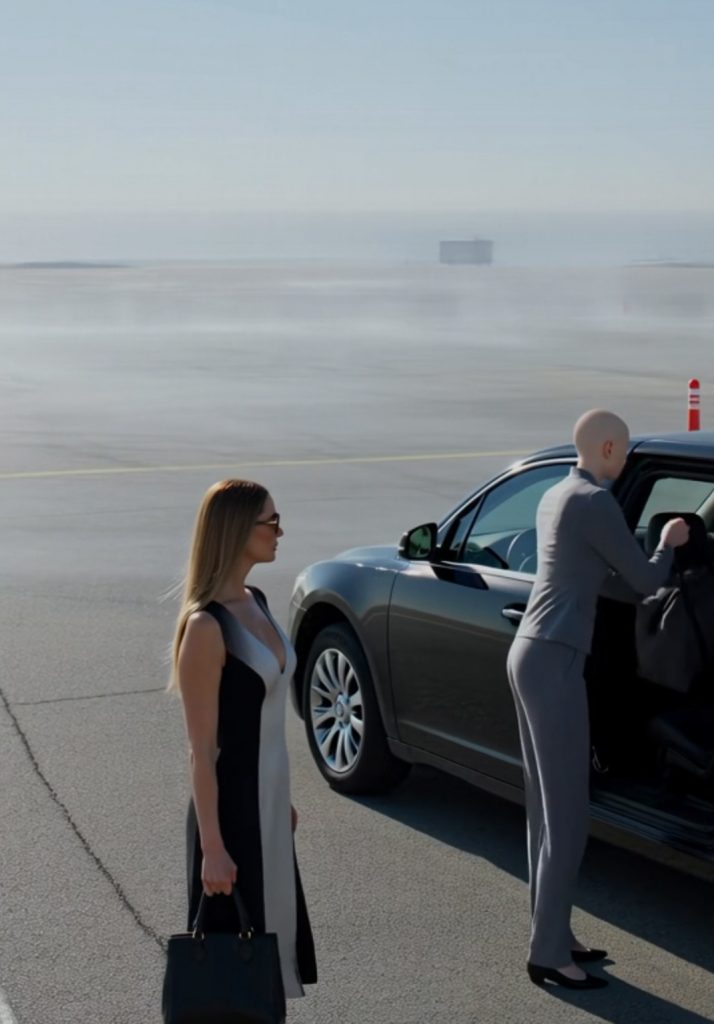
She adjusted her grip on her own luxury handbag, her posture radiating the entitlement of a queen who had never once considered that her throne could be anything less than eternal. She existed in a vacuum where the only voices that mattered were the ones that reinforced her own importance.
The distant, low-frequency rumble of the Gulfstream’s engines reached them before the plane itself came into full view, an imposing silhouette against the cloudless, piercing blue sky. The roar grew into a thunderous, mechanical symphony as the private jet taxied to a halt, the heat haze dancing off the cooling turbines.
As the cabin door hissed open and the motorized stairs descended, the air seemed to grow thick with an unspoken, heavy tension. Maya stood motionless, her hands clasped loosely in front of her, her gaze fixed on the descending stairs with a quiet, calm intensity that contrasted sharply with Isabella’s frantic, superficial agitation.
Julian Vance emerged from the cabin, and for a moment, the entire world seemed to pivot around him. He looked every bit the titan of industry—sharp-suited, composed, and emanating a calm, dangerous authority that seemed to silence the very wind.
He moved with a rhythmic, purposeful stride that commanded attention without needing to demand it. He was the architect of a media empire, a man who possessed the rare, lethal ability to read the landscape of a room the moment he entered it. But as his eyes swept over the tarmac, they bypassed his wife entirely.
His gaze did not linger on Isabella’s expensive dress or the forced, expectant smile she had hastily plastered onto her face. Instead, his eyes settled on the quiet woman in the gray uniform.
At that moment, the sterile atmosphere of the airfield was shattered by a sound so pure and unadulterated it felt like an intrusion: a joyous, high-pitched cry from a young boy. Maya’s son, standing just behind her with a small, worn backpack slung over his shoulders, had spotted him.
“Dad is here!” The boy’s voice pierced the rigid, sterile air—a sound of raw, unfiltered truth in a world that was otherwise governed by corporate masks, hidden agendas, and performative loyalty.
Isabella’s breath hitched. Her hand, which had been reaching out in anticipation of a greeting, froze in mid-air. The world she had curated—a world where she was the undisputed center of Julian’s life, where their marriage was a pristine pillar of their shared corporate empire—began to flicker and fade.
Julian did not descend toward his wife. He did not offer a nod or a polite acknowledgment of her presence. He walked straight past her, his focus locked entirely on Maya.
The silence that followed was absolute. It was the kind of silence that usually preceded a landslide. Julian reached them, and his face softened in a way Isabella had not seen in a decade—a genuine, warm look of connection that bypassed all the tactical barriers he maintained with the rest of the world.
He ignored the hand Isabella was still holding out, a gesture that now looked pathetic and small in the shadow of the massive jet. He went directly to Maya, taking her hands in his.
“Welcome, Chairman,” Maya said, her voice steady and soft, though her eyes betrayed a depth of complicity and quiet strength that Isabella couldn’t comprehend.
Julian’s grip on Maya’s hands was firm, a gesture of intimacy so public, so unrepentant, and so deliberate that it acted as a physical blow to Isabella’s composure.
“Thank you for waiting for me with our son,” he replied, his voice a low, resonant baritone that carried easily across the tarmac. “This long flight made me realize exactly what I was missing. It made me realize how much time I’ve been wasting in rooms full of people who don’t know the first thing about loyalty.”
Isabella, now trembling with a mix of visceral shock, humiliation, and a cold, rising rage, ripped her sunglasses off. Her face, a mask of carefully constructed, expensive perfection, finally cracked, revealing the raw, jagged disbelief underneath.
“Wait,” she gasped, her voice shrill and thin against the quiet, haunting hum of the idling jet engines. “She is your wife? You’re acting like this? In front of my staff? In front of me?”
Julian turned toward her, his expression hardening into a look of absolute, chilling finality. He didn’t answer with a defensive excuse, a plea for understanding, or a petty, reactive retort. He had moved beyond the need to engage with her on that level. He simply looked at Maya, then back at Isabella, his eyes cold and devoid of any lingering warmth.
“The Director of Media belongs to someone who understands the true value of respect,” Julian stated, his words cutting through the air like shards of glass. “You’ve spent your tenure as a partner in this company treating people like items in a closet, Isabella. You’ve curated a life of superficiality, expecting the world to bow to your name without you ever having to earn a single moment of genuine devotion.”
“It’s time you learned the difference between a master and a servant,” he continued, “and it’s time you realized that your title in this house has been revoked. The merger of our lives, just like the merger of our companies, is over.”
He signaled to an aide waiting near the limousines, who immediately stepped forward to escort Maya and her son toward a secondary, more discreet vehicle. Isabella was left standing alone on the tarmac, the vast, empty gray space suddenly feeling like a prison rather than a stage.
She watched as her husband—the man who was supposed to be the final, immutable anchor of her life—walked away, leaving her anchored to nothing but her own unraveling ego. The transition was complete. The illusion was gone.
And for the first time in her life, Isabella Vance realized that the power she had worshipped was nothing more than a ghost, a transient shadow that had finally been cast out by the light of a reality she had refused to acknowledge. The arrival had not been a homecoming; it had been an eviction.