The storm had a name no one would forget.
For ten years, people in the city would say that night and everyone would know what they meant. The night the sky broke open like it had been holding its breath for too long. The night wind screamed through streets like something alive. The night rain didn’t fall—it attacked.
And in the middle of it, a ten-year-old boy named Leo lost everything.
Leo didn’t remember the exact moment the fire started. Only the heat. The sudden roar. The way the world turned orange and then black and then nothing. One moment he was home, half-asleep on a couch too small for his growing body, and the next he was running barefoot through chaos, coughing, screaming for voices that never answered him again.
By the time the storm swallowed the city, Leo had no family left to call. No home to return to. No dry place in the world that belonged to him.
Only the rain.
He wandered through broken streets where power lines flickered like dying stars. Water rose around his ankles, then his knees. The wind pushed him sideways more than once, but he kept moving, because stopping felt like disappearing.
Leo didn’t know where he was going. Only that staying still meant giving up.
And then he heard it.
A sound smaller than the storm.
A cry.
At first, he thought it was his imagination—his mind playing tricks in the endless noise of wind and water. But then it came again. Faint. Fragile. Human.
He followed it.
Behind an overturned trash bin near the entrance of a flooded alley, there was a basket. Woven, old, half-submerged in rainwater. Inside it was a baby.
No more than a few months old. Wrapped in a thin cloth already soaked through. Lips trembling. Eyes barely open, searching for something it could not name.
Leo froze.
For a moment, the world stopped trying to kill him.
He looked around, expecting someone—anyone—to appear. A mother running back. A voice calling. Footsteps. Anything.
There was nothing.
Only storm.
The baby cried again, weaker this time.
Something inside Leo shifted. He didn’t have words for it. He only knew that the baby was going to die if he did nothing. And somehow, that thought hurt more than the cold.
Carefully, he lifted the basket. His hands were shaking so badly he almost dropped it. Then he pulled the baby into his arms.
“You’re okay,” he whispered, though he wasn’t sure if he was speaking to the child or himself. “You’re okay. I’ve got you.”
He took off his jacket—what was left of it—and wrapped it around the infant. It didn’t matter that he was now nearly bare against the storm. The baby needed warmth more than he did.
And so Leo walked again.
The city became a maze of water and darkness.
Cars floated like broken toys. Storefront windows shattered inward. Neon signs flickered and died. Every so often, Leo passed other people—adults mostly—some running, some shouting, some staring blankly at ruined lives.
No one stopped him.
He was just a child carrying another child through the end of the world
His feet burned with cold. His legs trembled with exhaustion. The baby grew heavier with every step, not because of weight, but because of responsibility—something far larger than Leo had ever been asked to hold.
“Just a little farther,” he kept saying. “Just a little farther.”
He didn’t know where the nearest police station was. He only knew what a sign looked like when he saw one, and when he finally spotted the faint blue reflection of emergency lights cutting through rain, he almost cried from relief.
But the station was still far.
And the storm was not done with him.
By the time Leo reached the building, he was no longer walking properly. He was stumbling forward on instinct, driven by one thought alone: don’t drop the baby.
His vision blurred. His fingers felt like stone. The cold had moved deeper than skin—it had settled into his bones, slow and heavy.
The police station doors finally came into view, glowing like a promise.
He pushed inside.
Warm air hit him like a wall.
People turned. Voices rose. But Leo heard none of it clearly. Everything was distant, underwater.
He took one step forward.
Then another.
“I… found… a baby,” he managed to say.
His knees gave out.
Officer Daniel Mercer had seen a lot of things in his years on duty. Violence. Accidents. People at their worst moments. He had trained himself to stay steady, to stay detached enough to function.
But when the doors opened that night, something broke through that discipline.
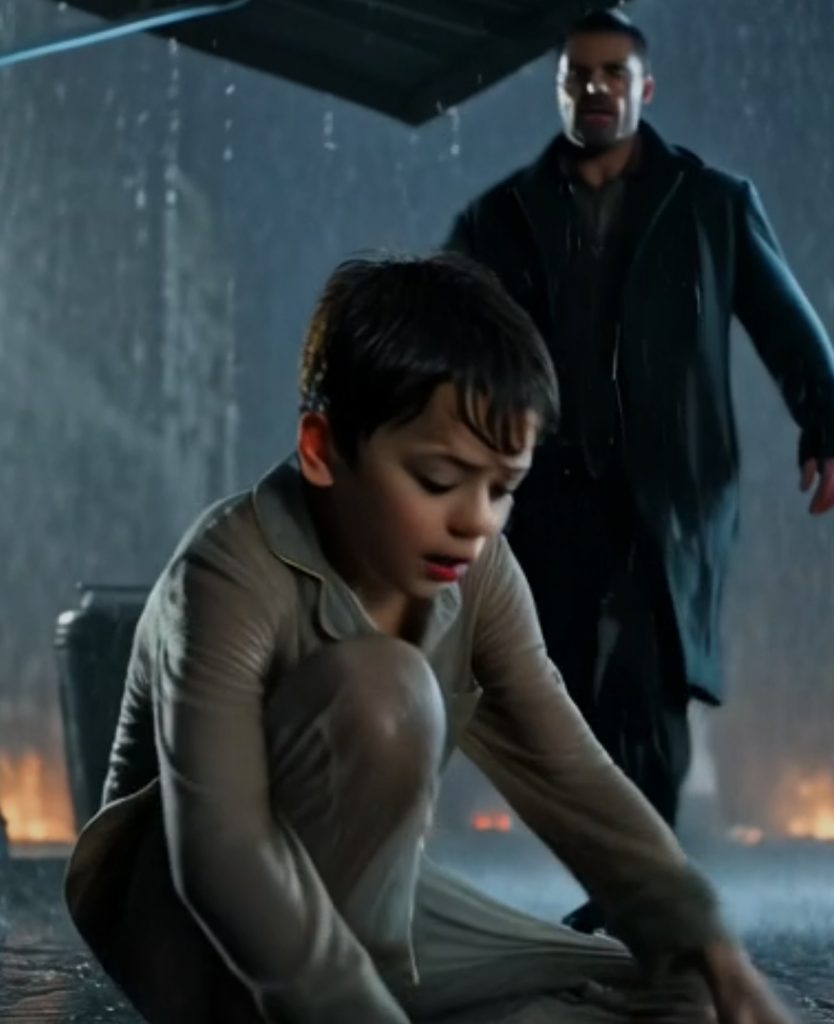
A small boy stood in the entrance.
Soaked. Shivering. Barely upright.
And in his arms—a newborn child wrapped in a soaked jacket.
The sight didn’t fit into any category Daniel knew. It wasn’t just emergency. It wasn’t just abandonment. It was something purer and more devastating.
The boy took one more step and collapsed.
Daniel moved before thinking.
He caught the baby first, carefully, instinctively. Then he knelt and lifted the boy into his arms. Leo was burning with cold, his lips blue, his breath shallow.
“Hey—hey, stay with me,” Daniel said sharply, though his voice softened halfway through.
Leo nodded, like that was the only answer that mattered.
Silence filled the room for a while.
Then Daniel asked, “Where’s your family, son?”
Leo hesitated.
Then he said, “Gone.”
One word. No detail. No explanation. But everything was in it.
Daniel swallowed.
For a long moment, he didn’t respond like a police officer. He didn’t respond like anything trained or official.
He responded like a man standing at a crossroads he didn’t expect.
Weeks later, after reports, investigations, and endless paperwork that never fully captured what had happened that night, decisions were made.
No relatives came forward for the baby.
No surviving guardians were found for Leo.
Two children. Both alone. Both alive because of each other.
And Officer Daniel Mercer made a choice that surprised even him.
He applied to adopt them both.
The day Leo was told, he didn’t react the way most people expected.
He didn’t cry.
He didn’t smile immediately.
He just asked, quietly, “Why?”
Daniel thought for a moment.
Then he said, “Because you already saved her. And someone should have saved you too.”
Leo looked down at his hands.
Small hands. Hands that had carried a life through a storm.
After a long silence, he nodded.
“Okay,” he said. “But… I don’t want her to feel like I did.”
Daniel crouched to his level.
“She won’t,” he said. “Not anymore.”
Months passed.
Then years.
The storm became a story people told instead of a threat they feared. The city rebuilt itself in layers of concrete and memory.
And in a small home not far from the station, laughter slowly replaced silence.
Leo grew. The baby grew too—named Mira.
And Daniel, once a man defined by rules and reports, became something else entirely.
A father learning what he had never been taught.
Sometimes, late at night, Leo would still wake up from dreams of rain. Daniel would sit beside him without saying anything until the boy calmed down.
Other times, Leo would watch Mira sleep and quietly say, “I’m glad I found her.”
And Daniel would always answer the same way.
“You didn’t just find her.”
He would pause.
“You saved her. And she saved you too.”
And in the quiet of that new life—far from storms, far from fire, far from the night that tried to erase them all—three people who once had nothing became something the world almost took away from them:
A family.