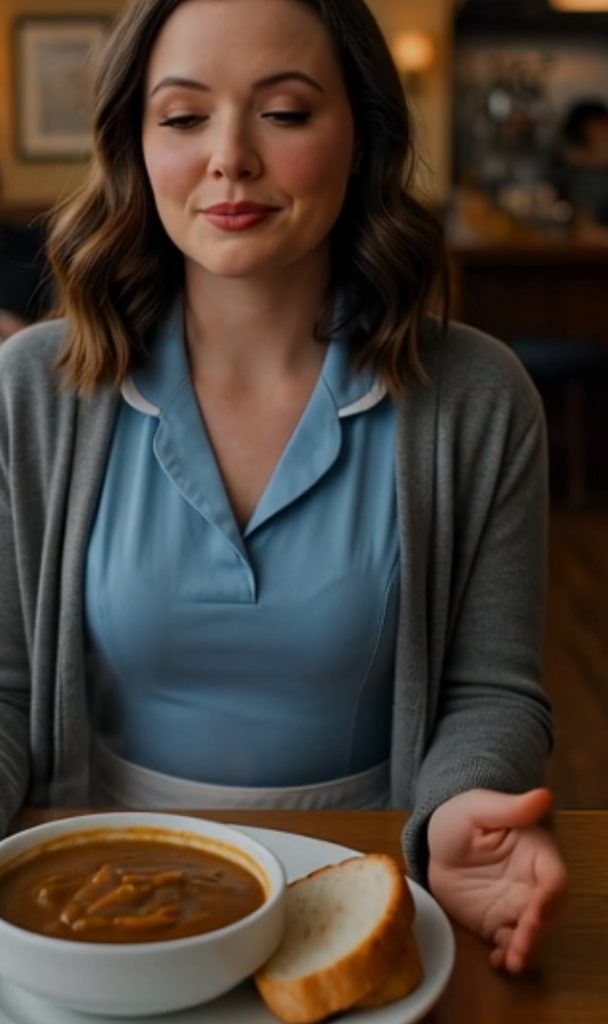
Chapter 1: The Ghost in the Corner Booth
The air inside The Copper Skillet was a suffocating blend of scorched coffee, frying grease, and the sharp, metallic tang of stressed humanity. It was a Tuesday afternoon, and the mid-city rush hour had packed every cracked vinyl booth with a cacophony of loud suits, exhausted nurses, and shouting line cooks. I was Emma, a twenty-two-year-old waitress balancing three precarious plates of meatloaf while trying to ignore the stabbing pain in my lower back.
I moved through the chaos like a ghost, invisible to the patrons unless their coffee cups ran dry. But while the city ignored me, I made it a point not to ignore the city.
That was how I noticed him.
He slipped through the heavy glass doors like a shadow attempting to avoid the sun. The man was elderly, his frame painfully thin, swallowed by a trench coat that had frayed at the cuffs and smelled of damp alleyways and forgotten winters. His shoes were held together by gray duct tape. He shuffled past the bustling center tables, his eyes cast downward, and folded himself into the darkest, smallest booth in the far back corner.
For nearly an hour, he sat there in absolute silence.
The diner continued to roar around him. A table of stockbrokers laughed uproariously over a joke I didn’t care to hear. A mother scolded her toddler. The floor manager, a perpetually red-faced tyrant named Marcus, paced the aisles, deliberately turning a blind eye to the vagrant taking up paying real estate. People possess a terrifying ability to selectively edit their reality. They looked right through the old man, pretending he was merely a smudge on the windowpane of their day.
But I couldn’t look away.
I watched as his hands—gnarled, deeply scarred, and trembling violently—clutched the laminated menu. He wasn’t reading it. His eyes were unfocused, staring at the glossy pictures of burgers and pies with a hollow, sunken despair. The tremor in his hands wasn’t from the chill of the autumn air. It was the frantic, mechanical vibration of severe, prolonged hunger.
Marcus caught my eye from across the room, tapping his wristwatch and scowling, silently demanding I clear table four.
I ignored my boss. I grabbed a fresh, steaming pot of coffee and a heavy ceramic mug, and walked directly toward the shadows of the back corner.
“Excuse me,” I said, my voice barely audible over the clatter of silverware.
The man flinched, his shoulders pulling up toward his ears as if expecting a blow. He slowly raised his head. His eyes were a pale, cloudy blue, etched with a map of profound suffering.
“I’m sorry,” he rasped, his voice sounding like dry leaves scraping across concrete. “I’ll leave. I was just… warming up.”
“You don’t need to leave,” I replied softly, pouring the dark liquid into the mug and pushing it toward him. The steam curled around his frozen fingers. “Are you hungry?”
The hesitation in his eyes broke my heart into a thousand jagged pieces.
Chapter 2: The Currency of Dignity
The old man stared at the coffee, the warmth radiating against his palms. He swallowed hard, the pride fighting a losing battle against his basic human biology.
He looked up at me, a sad, fractured smile touching the corners of his chapped lips. “I haven’t eaten today,” he admitted, the confession barely louder than a whisper.
I didn’t ask for an explanation. I didn’t offer a lecture on social services. I simply nodded, turned on my heel, and marched straight to the kitchen.
I bypassed the standard ordering carousel. I grabbed a pristine white plate and loaded it with the best we had: a massive cut of roasted chicken, a mountain of garlic mashed potatoes, and thick, buttery green beans. I ladled rich, dark gravy over the entire thing.
“Hey! Where’s the ticket for that?” the line cook barked.
“Take it out of my shift pay,” I snapped back, my tone leaving absolutely zero room for debate.
When I returned to the corner booth and set the steaming, heavy plate in front of him, the man stopped breathing. The aroma of roasted meat and butter hit him, and the stoic, invisible armor he wore completely dissolved. Thick, heavy tears welled in his pale blue eyes, spilling over his weathered cheeks and disappearing into his scruffy beard.
“I… I can’t pay for this,” he stammered, his hands shaking so badly he couldn’t even pick up the fork. “I have nothing.”
I reached across the table and gently rested my hand over his trembling knuckles. His skin was ice-cold.
“You don’t have to,” I smiled, ensuring my voice carried nothing but warmth. “It’s already taken care of. Just eat.”
I stepped away, giving him the dignity of privacy. From the corner of my eye, I watched him consume the meal with a desperate, frantic reverence, treating every single bite as if it were an absolute miracle. He didn’t leave a single crumb on the porcelain.
Twenty minutes later, my shift was ending. I was wiping down the counter when I felt a presence beside me.
beneath my feet.
The homeless man I had helped had never forgotten my kindness.
And looking at the son, standing in the storm to deliver his father’s final debt, I realized that neither had his family.
“He told me to find you,” the young man smiled, placing his hand gently on my shoulder. “He told me to wait until you truly needed it.”
I looked at the cashier’s check in my hand, then back to the receipt. The world is a brutal, unforgiving machine that grinds the vulnerable into dust. But hidden within the gears are invisible threads of grace, binding us together in ways we cannot possibly comprehend.
I had given away a plate of chicken and potatoes.
In return, a ghost had reached across time to save my life.
Epilogue: The Echoes of Compassion
It has been three years since that afternoon in Centennial Park.
I am no longer sitting on cold benches holding pink notices. I used the money to clear my debts, secure a small apartment, and finally enroll in nursing school. Next month, I will walk across a stage and receive my degree.
I work in the psychiatric ward of the city hospital now. I deal with the broken, the wandering, and the forgotten. I see the people the rest of the city chooses to selectively edit out of their reality. And every single time I walk into a patient’s room, I look them in the eye. I make sure they know they are seen.
I keep the green diner receipt framed on my desk. It is the most valuable thing I own.
It serves as a constant, unwavering reminder of the true architecture of our world. We are entirely defined by the mercy we afford to those who can offer us nothing in return. Kindness is not a transaction; it is an investment in the human soul.
And sometimes, when you least expect it, that investment comes back to find you in the rain.
If you want more stories like this, or if you’d like to share your thoughts about what you would have done in my situation, I’d love to hear from you. Your perspective helps these stories reach more people, so don’t be shy about commenting or sharing.