Chapter 1: The Arena of Prestige
The air inside the Metropolitan Concert Hall was thick, suffocating beneath the weight of ambition, expensive perfumes, and the collective anticipation of three thousand patrons. This wasn’t merely a performance venue; it was an arena where futures were forged or shattered under the unforgiving glare of theatrical lighting. Tonight was the final, definitive round of the Crescendo Invitational, a televised spectacle that promised the victor a life-altering cash prize, a lucrative recording contract with a premier studio, and immediate entry into the upper echelons of the classical music world.
sat in the darkness of the wings, the heavy velvet curtain brushing against my shoulder. Out there, past the brilliant white spotlight, the judges sat perched behind a sleek, illuminated table like modern-day emperors in a colosseum. They were the titans of the industry—renowned conductors, ruthless producers, and severe professors from conservatories that required generational wealth or miraculous prodigy status just to audition.
performances leading up to this moment had been demonstrations of polished perfection. I had watched a young man coax furious, flawless sonatas from a grand piano that cost more than my entire life’s earnings. I had seen a cellist whose instrument gleamed with fresh varnish, producing tones so rich they vibrated in my chest. Each act was met with escalating waves of thunderous applause, the audience hungry for technical brilliance and pristine presentation.
And then, there was me.
My name is Elara, though that hardly mattered to the people out there. To them, I was just the next contestant, a brief interlude between the polished prodigies.
The current act—a dazzling display of electric violin gymnastics—concluded to a standing ovation. The host, a man whose smile seemed permanently affixed to his face, strode confidently into the center of the stage, his tailored suit catching the light.
“And now, ladies and gentlemen,” his voice boomed through the impeccable sound system, smooth and practiced, “please welcome the next contestant vying for the grand prize tonight.”
My name flashed across the massive digital screens flanking the stage. Elara Vance.
I took a deep, shuddering breath. My palms were slick with cold sweat. I gripped the neck of my violin tighter, the familiar, worn wood grounding me. It was time.
I stepped out from the shadows of the wings and into the blinding pool of the spotlight.
The immediate reaction was not applause. It was a physical, audible ripple of shock. It started as a low murmur in the front rows and quickly spread, a wave of surprised, judgmental whispers washing over the cavernous hall.
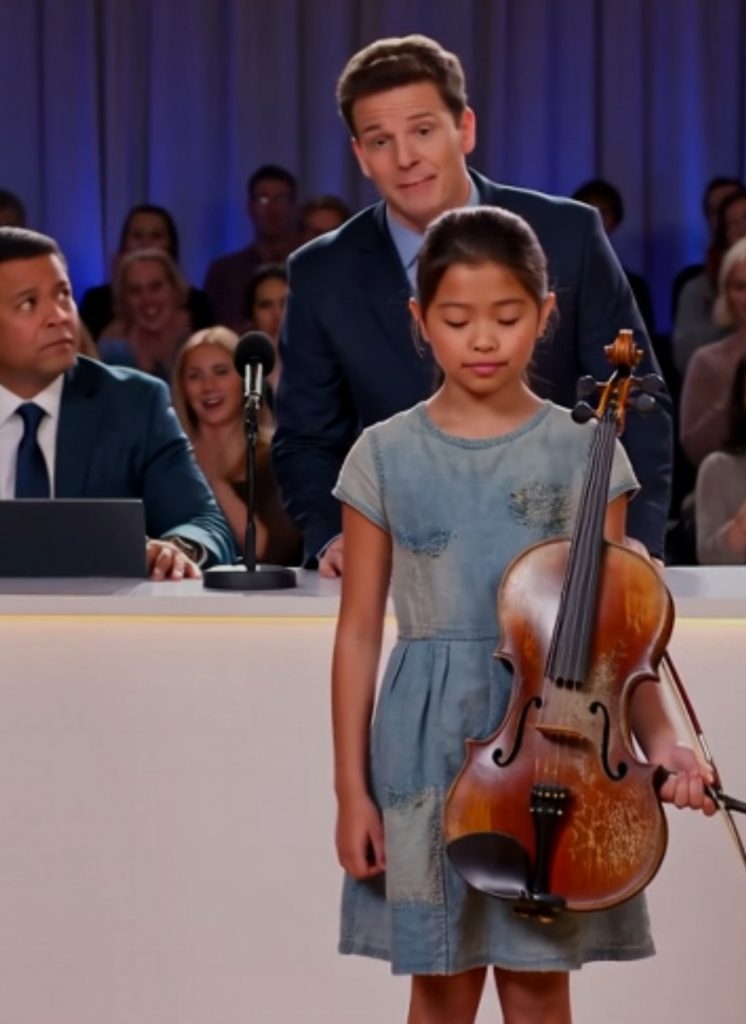
I knew exactly what they saw. I was a glaring, offensive anomaly in their gilded world. I am thin, perhaps too much so, and I wore a dress that had seen better days long before it found its way to a thrift store rack. My dark hair was pulled back carelessly, escaping in messy strands around my face. My shoes were scuffed, the leather cracked. I kept my gaze fixed firmly on the polished wooden floorboards, feeling the crushing weight of three thousand eyes dissecting my poverty.
But it wasn’t my frayed clothing that truly incited the audience’s disbelief. It was the instrument clutched defensively against my chest.
It was an old violin. To call it vintage would be an insult to the pristine antiques resting in velvet cases backstage. The varnish had been stripped away by decades of harsh use, leaving the wood exposed and vulnerable. The body was a roadmap of deep scratches and jagged cracks. One entire section of the ribbing had been clumsily repaired, a patchwork of uneven wood and hardened glue that looked like a desperate, amateur surgery.
I heard the sharp intake of breath from a woman in the third row. I saw the exchanged, incredulous glances between two men in tailored tuxedos.
Then, the first, solitary bark of laughter echoed through the silence.
The host approached me, his practiced smile faltering slightly as his eyes swept over my frayed hem and the battered instrument. A cruel, amused smirk began to tug at the corner of his mouth.
“Tell me honestly, sweetheart,” he said into the microphone, his voice dripping with condescension that amplified perfectly across the hall, “are you genuinely intending to perform with that piece of wood?”
A hot flush of humiliation violently seized my cheeks. My throat tightened, threatening to choke off my voice. I forced myself to nod, a small, barely perceptible movement.
Yes,” I murmured, my voice trembling.
The host let out a short, theatrical laugh. “Well, I must admit, I thought artifacts in that condition belonged exclusively behind museum glass. Or, perhaps, at the bottom of a salvage bin.”
The laughter was immediate and cruel. It rolled through the hall like a physical force, battering against me. Some audience members, emboldened by the host’s mockery, actually clapped at the joke.
I dared to glance toward the judges’ table. One of the producers, a man with silver hair and a sharp suit, was chuckling openly.
“I believe,” the producer leaned into his microphone, his voice cutting through the amusement, “that violin might actually predate the architectural foundation of this very building.”
The laughter swelled, growing louder, more unified. It was the sound of a collective turning against an intruder.
Another judge, a stern-faced professor from a prestigious academy in Vienna, chimed in, her tone laced with aristocratic disdain. “Let us merely pray the structural integrity holds long enough for her to finish tuning. We wouldn’t want splinters on the stage.”
Even from the wings, I could hear the muffled snickers of the other contestants—the polished prodigies finding amusement in my humiliation.
I stood completely motionless, trapped in the center of the blinding light. Every instinct screamed at me to turn around, to flee back into the comforting obscurity of the shadows, to escape this arena of cruelty. My legs felt like lead; my chest was a hollow drum of panic.
But I didn’t move. My fingers traced the deep gouge along the neck of the violin—a gouge created by my father’s calloused thumb over thousands of hours of playing.
I tightened my grip. I forced my head up, looking directly into the blinding light, addressing the darkness beyond it.
“Please,” I said softly, yet my voice carried a desperate, steel-edged clarity. “Just… give me the opportunity to play.”
The laughter began to subside, replaced by an uncomfortable, shifting silence. The host, sensing the mood turning from amusement to awkwardness, shrugged his shoulders dramatically.
“Well, the rules state this is a competition of musical merit,” he conceded, stepping back toward the edge of the stage. “The floor is yours, miss. Let’s see what you can do.”
I was completely alone in the center of the world. The silence in the hall was heavy, skeptical, and waiting for me to fail. I raised the battered violin, resting it gently against my collarbone. I positioned the bow, the horsehair worn and frayed.
As I closed my eyes, I wasn’t in the Metropolitan Concert Hall anymore. I was standing on a freezing street corner, the wind howling, waiting for the first note to drop.
I lowered the bow. I kept my head down, my chest heaving, the slick sweat on my hands making it difficult to grip the wood.
For five agonizing, endless seconds, nobody moved. Nobody breathed. The silence was heavier than the music had been. The massive hall seemed entirely incapable of processing the emotional violence they had just witnessed.
They hated it, a dark, panicked voice whispered in my mind. It was too raw. Too ugly.
Then, a single man in the fifth row stood up. He brought his hands together in a sharp, resounding clap.
It was the catalyst.
The entire audience—three thousand people—rose to their feet in a synchronized, violent wave. The silence shattered into an explosive, deafening roar of thunderous applause. It wasn’t polite, measured clapping. It was a chaotic, visceral release of emotion.
People were shouting, their voices lost in the din.
“Bravo!”
“Incredible!”
“More! Please, more!”
I looked up, stunned. Men in expensive suits were wiping tears openly from their faces. Women in evening gowns were cheering until their voices went hoarse. The host, the man who had mocked me so mercilessly just ten minutes ago, stood frozen on the side of the stage, his microphone hanging loosely by his side, his face pale with shock.
Suddenly, a loud, electronic chime cut through the applause.
The silver-haired producer had slammed his hand down on the glowing ‘Finalist’ button on his desk. Immediately, the other three judges lunged forward, their hands slamming down on their respective buttons in rapid succession. The stage was bathed in a brilliant, golden light, the universal signal of an automatic advancement to the grand finale.
The cheers grew even louder, vibrating through the floorboards. I stood there, trembling, clutching the scarred violin to my chest like a shield, overwhelmed by a validation I had never dared to imagine.
But the performance was over. The true revelation was yet to come.
“I never bought a new one,” I declared, tears finally spilling over my cheeks. “Because this isn’t just wood and string. This is his voice. I promised him they would hear it.”
For several agonizing seconds, nobody said a word. The weight of the revelation hung in the air, heavy and profound. The mockery, the judgment, the elite superiority—it had all been dismantled by the undeniable truth of a daughter’s love and a street musician’s final wish.
Then, the producer slowly stood up from his chair. He didn’t say a word. He simply began to clap.
The professor from Vienna stood up next. Then the host.
And then, the entire hall exploded once again. But this applause was different. It wasn’t just appreciation for a musical performance. It was an apology. It was a recognition. It was the sound of three thousand people honoring a ghost who had finally made his debut on the grandest stage of all.
I stood in the center of the light, the tears flowing freely now, clutching my father’s violin to my chest.
We had made them listen.