The police were already outside.
But Victor didn’t know that yet.
Darla didn’t know it either.
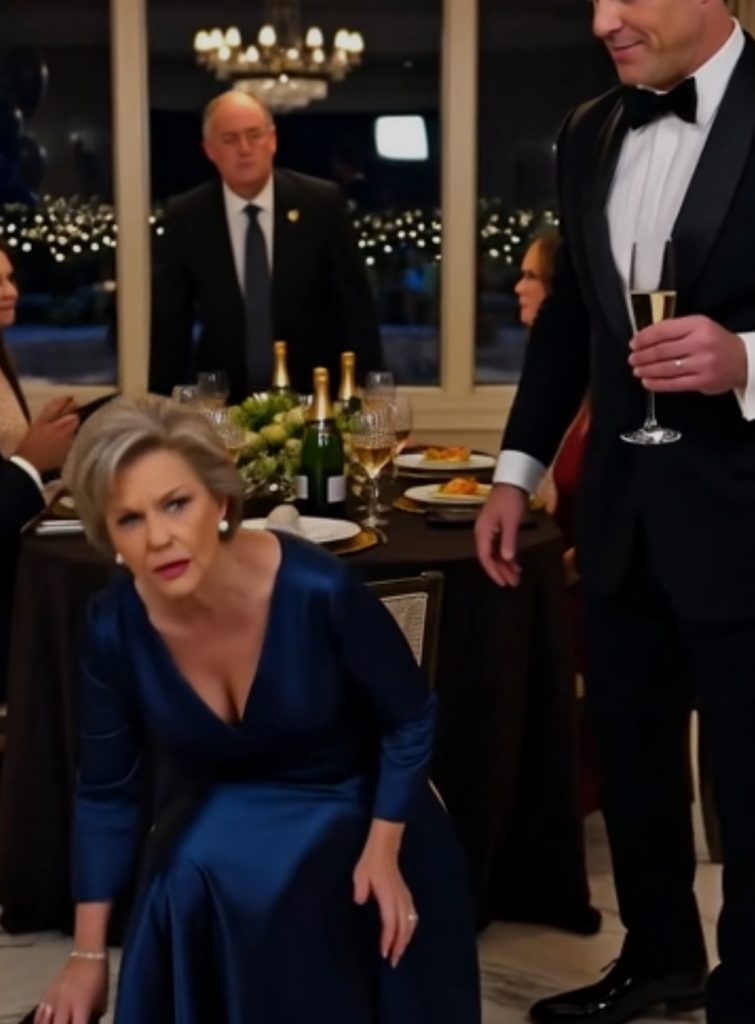
All they saw was me on the marble floor, one hand pressed to my mouth, my silver evening wrap twisted under my knees like a rag.
And for the first time all night, nobody laughed.
Victor’s face changed first.
It was small.
A flicker.
The kind of fear a gambler gets when he realizes the dealer has turned over a card he never counted.
“What did you just say?” he asked.
I stayed where I was.
Not because I couldn’t stand.
Because for once, I wanted everyone in that room to keep looking.
The Aspen resort’s private dining room had been built for people who never apologized.
Forty-foot windows.
Snow falling behind the glass.
Champagne towers.
White roses.
A string quartet in the corner.
And twenty-three members of Victor’s family watching a sick woman get humiliated like halftime entertainment.
Victor Hart had spent thirty-one years telling people he was the reason we had money.
He wore custom tuxedos.
He flew private.
He tipped waiters with other people’s money, then called it generosity.
And when his gambling got worse, when the casino weekends became “business trips,” when a blackjack dealer named Darla started appearing in photos she was never supposed to be in, Victor became cruel in that polished, country-club way.
Not loud at first.
Just sharp.
“You’re tired because you like being pitied.”
“You don’t understand finance.”
“You’re lucky I kept this family respectable.”
Then I got sick.
And his cruelty got confident.
That was the part people missed.
Some men don’t leave when their wives get weak.
They wait.
They study the weakness.
They build a plan around it.
At the dinner table that night, Victor had arranged everything.
He seated me far from the center.
He placed Darla beside him.
He let her wear my gown.
He invited her friends.
He told his relatives I had been “emotionally unstable.”
He even raised a toast before dessert.
“To new beginnings,” he said, staring at Darla.
Everyone understood what he meant.
Nobody stopped him.
I remember my nephew looking down at his plate.
I remember my sister-in-law, Marjorie, whispering, “Victor, maybe not tonight.”
Victor smiled.
“Tonight is exactly right.”
Then Darla stood.
She was forty-four, beautiful in the glossy way casinos teach women to be beautiful under bad lighting. Her hair was curled over one shoulder. Diamonds flashed at her throat. The silver couture gown shimmered when she moved.
My gown.
She touched the fabric and said, “Evelyn, I hope you don’t mind. Victor said you wouldn’t be needing clothes like this anymore.”
A few people laughed because rich families often laugh when they are uncomfortable and want to stay invited.
I said nothing.
That bothered Darla.
So she stepped closer.
“You know what’s sad?” she said. “A woman who thinks a ring makes her permanent.”
Victor leaned back in his chair like a king at a trial.
“Tell them what you told me,” he said.
Darla tilted her head.
“That Evelyn has been meeting a man in Denver. That she’s been draining accounts. That she’s been lying about being sick.”
Gasps moved around the table.
Phones came up.
Not one person asked for proof.
Victor took a folded paper from his jacket and waved it toward me.
“I have statements. Hotel charges. Messages. Enough to file tomorrow.”
He didn’t.
Of course he didn’t.
He had pieces.
Screenshots without context.
Charges he had created.
Messages sent from a burner phone.
A story built by a desperate man who thought humiliation could move faster than evidence.
I still said nothing.
Because for six months, I had trained myself not to react.
Not when the pills made me dizzy.
Not when the doctor asked who had access to my supplements.
Not when my private investigator sent the first photos of Victor and Darla entering a casino hotel suite.
Not when my banker called and said, “Mrs. Hart, your husband attempted to move assets from a trust he does not control.”
Not when I found a tiny tear in the seal of my medication bottle.
Silence had become my safest room.
But Darla mistook silence for surrender.
She came around the table and stood over me.
“Get up,” she said. “At least leave with dignity.”
I looked at Victor.
“You’re allowing this?”
His smile was almost gentle.
“Dignity is earned.”
Then he pushed my shoulder.
Hard enough that my cane slipped.
Hard enough that the whole table saw me fall.
My hip hit the marble.
A crystal glass shattered beside me.
The quartet stopped.
Darla stepped forward and slapped me.
The first slap shocked the room.
The second made some people look away.
The third made her friends laugh.
Victor did not move.
That was when something inside me went completely still.
Not broken.
Still.
Like a lake before it freezes.
Darla bent down until her perfume filled my lungs.
“Do you know what Victor told me?” she whispered. “He said by tomorrow, I’ll have the house, the accounts, and the name.”
I looked at the hem of the silver gown dragging near the broken glass.
“No,” I said softly. “You won’t.”
She laughed.
“Listen to her. She thinks she still owns something.”
That was when Dr. Alan Mercer stood up.
Dr. Mercer had treated me for eight months.
He was not a dramatic man.
He wore brown glasses.
He still carried paper files because he said screens made people lazy.
He placed a sealed medical folder on the table and kept his hand on top of it.
“Victor,” he said, “I strongly advise you to stop speaking.”
Victor’s eyes narrowed.
“Doctor, this is family business.”
“No,” Dr. Mercer said. “It became criminal business when your wife’s lab results stopped matching her prescribed medication.”
The room froze.
Darla’s smile fell apart.
Victor laughed once.
Too loud.
“That is absurd.”
Dr. Mercer looked at the resort manager.
“I already provided a preliminary statement to the authorities.”
That was when my private investigator, Ruth Bell, stepped from behind the glass wine wall.
She was sixty, short, gray-haired, and invisible in the way only very skilled women can be.
She held a black envelope.
Victor saw it and went pale.
Because gamblers know envelopes.
They know when something has been collected.
Ruth laid the envelope beside the medical folder.
“Photos,” she said. “Hotel records. Casino surveillance logs. Payment receipts. Pharmacy footage. Burner phone purchases. Courier signatures.”
Darla took one step back.
Her heel caught the edge of the gown.
My gown.
Victor pointed at Ruth.
“You can’t just walk into a private event.”
Ruth smiled.
“I was invited by the person who paid for the room.”
He looked at me then.
Really looked.
Not at the bruised lip.
Not at the weak hands.
At the phone in my palm.
I pressed the call button I had already prepared.
My private banker answered on speaker.
“Mrs. Hart?”
The entire room heard his voice.
I looked at Victor.
“Freeze every trust connected to my husband. Suspend all discretionary payments. Flag all attempted transfers from the Hart marital accounts. Notify Zurich, Geneva, London, and San Francisco.”
The banker did not hesitate.
“Confirmed.”
Victor’s mouth opened.
Nothing came out.
Darla whispered, “What trusts?”
That was the first time she sounded young.
Not glamorous.
Not victorious.
Young and scared.
Victor snapped, “Evelyn, hang up.”
I didn’t.
The banker continued.
“Mrs. Hart, should we also execute the emergency misconduct clause?”
Victor grabbed the back of a chair.
“What clause?”
I looked at the relatives who had watched me bleed onto marble.
Some looked ashamed.
Some looked terrified.
Some were still recording, but their hands were shaking now.
“Yes,” I said. “Execute it.”
The banker replied, “Done.”
One word.
That was all it took to shut down Victor’s empire.
Not because I was lucky.
Not because I was cruel.
Because every dollar Victor had used to make himself look powerful came from structures he had never bothered to read.
Thirty-one years earlier, when I married him, I had already built my first company.
Not the company people knew.
That came later.
Before the headlines.
Before the patents.
Before the quiet acquisitions.
I had written code in a rented Palo Alto office with a broken heater and three engineers who believed the future would run on secure systems.
We built identity architecture for banks.
Then for hospitals.
Then for governments.
I sold the first company and used the money to buy back pieces of my family’s old European holdings.
The world called Victor a financier because he enjoyed cameras.
The world called me “private” because I refused interviews.
That suited me.
Power is safer when vain people think it belongs to them.
Victor knew I had money.
He did not know how much.
He knew my family had roots in Europe.
He did not know those roots still owned banks, shipping companies, real estate portfolios, and technology rights scattered across four countries.
He knew I signed documents.
He never read them.
That was his fatal flaw.
He mistook my quietness for permission.
The Hart family trust was not his.
The Aspen house was not his.
The jet was not his.
The foundation was not his.
Even the resort suite he had booked to impress Darla had been billed to an account my office controlled.
Victor had been living inside a palace with his name on the napkins and mine on the deed.
Darla turned to him.
“Victor?”
He didn’t answer.
So she asked the question everyone else was thinking.
“Who is she?”
Before Victor could lie again, the private dining room doors opened.
Two Aspen police officers stepped in with the resort’s security director.
Behind them came a tall woman in a black coat carrying a garment bag.
My attorney, Caroline Voss.
She was not smiling.
Caroline walked to my side first.
She helped me stand.
That mattered.
Not the papers.
Not the police.
That one hand under my elbow.
“Are you ready?” she asked quietly.
I nodded.
Caroline faced the room.
“Victor Hart, Darla Lane, and any person who participated in tonight’s staged accusation should understand that Mrs. Evelyn Hart is prepared to cooperate fully with law enforcement.”
Victor tried to recover.
He straightened his tuxedo.
“This is a marital disagreement.”
Caroline opened a folder.
“No. This is suspected financial fraud, elder abuse, evidence tampering, and potential poisoning. Dr. Mercer’s report has already been submitted. The pharmacy footage has already been preserved. The bank transfer attempts have already been flagged.”
Darla’s friend whispered, “Poisoning?”
Dr. Mercer turned a page.
“Mrs. Hart’s test results indicated repeated exposure to a sedative not included in her treatment plan.”
The room erupted.
Marjorie stood up.
“Victor, tell me that isn’t true.”
Victor shouted, “Everyone calm down!”
That made it worse.
Guilty people always ask for calm after they create chaos.
One of the officers approached him.
“Mr. Hart, we need you to step outside with us.”
Victor pointed at me.
“She set this up. She’s angry because I’m leaving her.”
Caroline’s voice stayed flat.
“Your affair is not the issue. Your attempt to frame your wife for infidelity while moving restricted assets and interfering with her medication is the issue.”
Darla suddenly moved toward the side door.
Ruth Bell blocked her.
Not with force.
With a small smile and one sentence.
“Your suitcase is already in resort security.”
Darla froze.
Caroline lifted the garment bag the woman in black had brought in.
“And this gown,” Caroline said, “is registered property from the Moreau archive in Paris. It was never loaned, sold, gifted, or transferred to you.”
Darla touched the silver fabric.
Victor muttered, “It’s just a dress.”
Caroline looked at him.
“It is an insured couture artifact valued at $1.8 million.”
Darla’s hand flew off the fabric.
The relatives gasped louder at the dress than they had at my bruised face.
That told me everything I needed to know about them.
Caroline continued.
“Ms. Lane, resort security will escort you to change. The gown will be returned to the archive representative tonight.”
Darla’s eyes filled with tears.
Not regret.
Fear.
“Victor said it was mine.”
I looked at her.
“No. Victor said many things.”
For the first time, Darla had no comeback.
Security led her away through the side hall.
Her friends did not follow.
They suddenly became fascinated with their phones.
Victor watched her go, then turned back to me.
“Evelyn,” he said, softer now. “Let’s talk privately.”
I almost laughed.
The man had shoved me in public.
Let me be slapped in public.
Called me unstable in public.
Tried to erase me in public.
But consequences?
Those he wanted private.
“No,” I said. “You made this a family performance. Stay onstage.”
Caroline placed another document on the table.
It was thick.
Bound.
Tabbed in red.
Victor recognized the cover.
The postnuptial amendment.
The one he had signed twelve years earlier after his first gambling scandal, when he cried in our kitchen and promised he would get help.
He had signed it with a shaking hand, barely reading past the first page.
The amendment had one clear clause.
Any attempt to misappropriate protected assets, fabricate marital misconduct, or endanger my medical care would trigger immediate forfeiture of spousal benefits, repayment of unauthorized losses, and personal liability for damages.
Victor had thought marriage meant access.
The contract said otherwise.
Caroline slid a pen across the table.
“Sign the settlement acknowledgment.”
Victor stared at it.
“You can’t force me.”
“No,” Caroline said. “A judge can. But tonight you have the option to preserve what little cooperation credit remains.”
He looked around the room.
Nobody rescued him.
Not his brother.
Not his cousins.
Not the friends he had flown in.
That is another thing money teaches you.
Crowds cheer power.
They abandon liability.
Victor picked up the pen.
His hand shook.
“How much?” he whispered.
Caroline answered.
“Current estimate: $2.4 billion in repayment exposure, penalties, clawbacks, and guaranteed obligations tied to the emergency clause.”
Darla screamed from the hallway.
Victor dropped the pen.
The sound was tiny.
But it felt like a chandelier falling.
“You’re destroying me,” he said.
I shook my head.
“You did that when you mistook patience for weakness.”
The officer stepped closer.
“Mr. Hart.”
Victor signed.
Not because he was sorry.
Because for once, the room belonged to rules he couldn’t charm.
After he signed, the police escorted him out past the same relatives who had filmed me on the floor.
Nobody applauded.
Nobody spoke.
Only the snow kept falling behind the glass.
When Darla returned, she was no longer wearing silver couture.
She had on a resort robe and winter boots, mascara streaking down her face.
She saw Victor being taken down the hall and ran after him.
“Victor! Tell them I didn’t know!”
He didn’t even turn around.
That was her ending with him.
Not romance.
Not loyalty.
Just a hallway, a robe, and silence.
Caroline handed me a clean wrap.
Dr. Mercer checked my lip and my pulse.
Ruth gathered the envelope.
The resort manager kept apologizing until I finally raised my hand.
“Stop apologizing,” I said. “Start preserving the footage.”
He nodded quickly.
“Yes, Mrs. Hart.”
The name sounded different in that room now.
Not louder.
Heavier.
Marjorie came toward me crying.
“Evelyn, I didn’t know.”
I believed her.
But belief was not forgiveness.
“You knew enough to look away,” I said.
She stopped.
That sentence did more damage than shouting ever could.
One by one, the relatives lowered their phones.
Some deleted nothing.
Some probably sent the videos before they thought better of it.
It didn’t matter.
By morning, every person at that dinner would understand that public cruelty creates public records.
The next weeks were not glamorous.
That is the part people skip in revenge stories.
There were statements.
Depositions.
Doctors.
Bank audits.
Court filings.
Insurance claims.
Reporters outside buildings.
Victor’s casino markers surfaced.
Darla’s payments surfaced.
The burner phone surfaced.
The pharmacy video showed a man from Victor’s security staff picking up medication under a name that was not his.
The staffer took a deal.
He said Victor had ordered him to “keep Mrs. Hart manageable” before the holiday dinner.
That phrase appeared in the police report.
Manageable.
As if I were a schedule.
A problem.
A woman to be softened before being erased.
Victor’s lawyers tried to call it a misunderstanding.
The judge did not enjoy that.
The trusts remained frozen.
His memberships were revoked.
His board seats vanished.
His old friends became “unavailable.”
Darla was charged separately for theft, fraud-related conduct, and false statements connected to the setup. Her casino license review became public. The friends who clapped for her that night suddenly released statements about “not knowing the full situation.”
Of course they didn’t.
People never know the full situation when the bill arrives.
Six months later, the civil settlement was finalized.
Victor left with almost nothing liquid, enormous personal obligations, and a reputation no tailored suit could repair.
Darla left Aspen in debt, facing court dates, and barred from the rooms she once thought she would own.
As for me?
I went back to work.
Quietly.
I kept my doctors.
I changed my locks.
I donated the silver gown to a museum archive with one condition: it would never be worn again by anyone who thought fabric mattered more than dignity.
On the first warm day of spring, I flew from Aspen to San Francisco.
The pilot asked if I wanted the city approach.
I said yes.
The jet curved over the bay.
The skyline rose through morning light.
Below me were buildings filled with companies I had funded, people I had hired, systems I had helped build while Victor was busy pretending power was a watch, a car, a mistress, and a louder voice.
I thought I would feel triumphant.
I did.
But I also felt free.
There is a difference.
Triumph is watching someone fall.
Freedom is realizing you no longer need to watch.
That evening, Dr. Mercer texted me:
“Labs look better. Keep resting.”
Ruth sent one line:
“Final footage secured.”
Caroline sent a photo of the signed settlement locked in a fireproof file.
I sat by the window of my San Francisco home, wrapped in a plain cashmere blanket, drinking tea from a chipped mug I had owned since my twenties.
Not couture.
Not champagne.
Not revenge.
Just peace.
And peace, after betrayal, feels richer than any empire.
So choose a side:
Was Evelyn too ruthless for freezing everything in front of the whole family…